

机场智能数据中心与AOC解决方案

Application Scenario

Intelligent Airport Data Center and AOC Solution

As the convergence point of passenger and cargo flows, airports have a particularly strong demand for intelligent technologies. Since the concept of the "Smart Airport" was introduced in 2011, building smart airports has become a major focus in the civil aviation industry today.


Industry Challenges

Resource Overload
Due to excessive flight scheduling or overuse of resources, aircraft takeoff and landing slots are underutilized, leading to low operational efficiency despite resource abundance.
Expand all
Poor Passenger Experience
Cumbersome boarding procedures, low baggage retrieval efficiency, and delayed boarding notifications result in unsatisfactory passenger service experiences.
Expand all
Fragmented Safety Management
Poor interconnectivity among security checks, flight operations, and support systems prevents correlated analysis and comprehensive monitoring. The lack of a unified safety management closed-loop system leads to low efficiency in responding to safety incidents.
Expand all
Insufficient Decision Accuracy
The absence of a unified display interface and panoramic data view forces controllers to rely on fragmented information, resulting in low decision-making accuracy and difficulty meeting visitor reception requirements.
Expand all

Our Methodology

Data Middle Platform: Breaking Down Business Silos

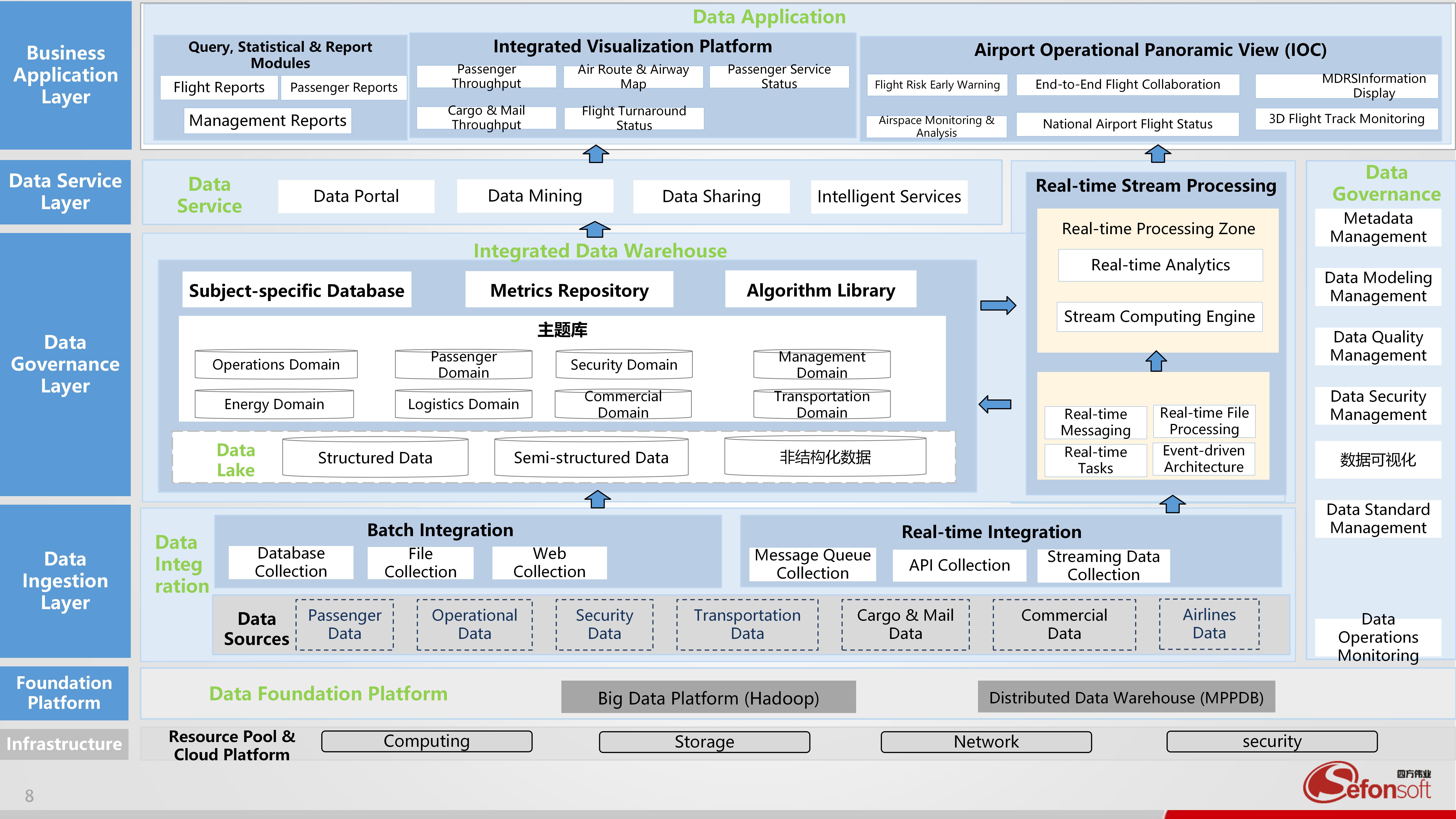
Leveraging IoT, internet technologies, and others, effectively collect and integrate internal and external airport data from nearly one hundred core systems. Using ETL technology, build data models to extract value from scenarios such as flight prediction, resource scheduling, and passenger behavior analysis. Through early warning monitoring and intelligent decision modules, empower closed-loop safety incident handling, optimize flight punctuality, and meet the overall control needs of a smart airport.

Digital Twin: Constructing a “One-Map Airport Operation”

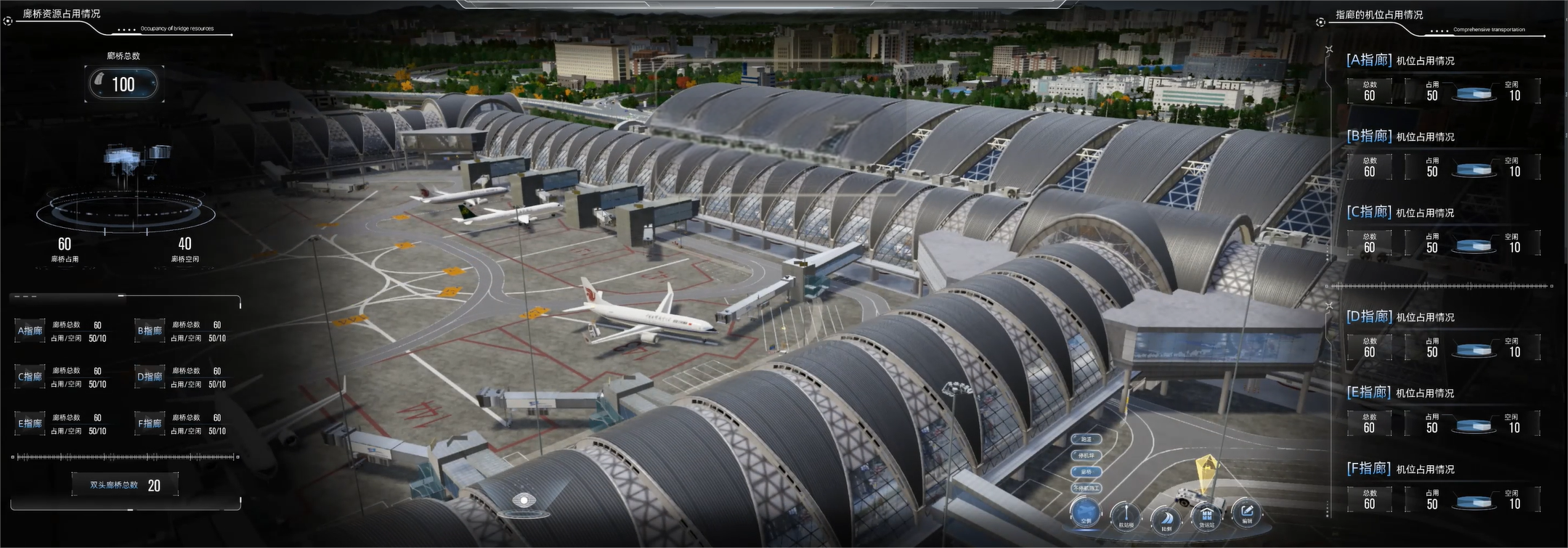
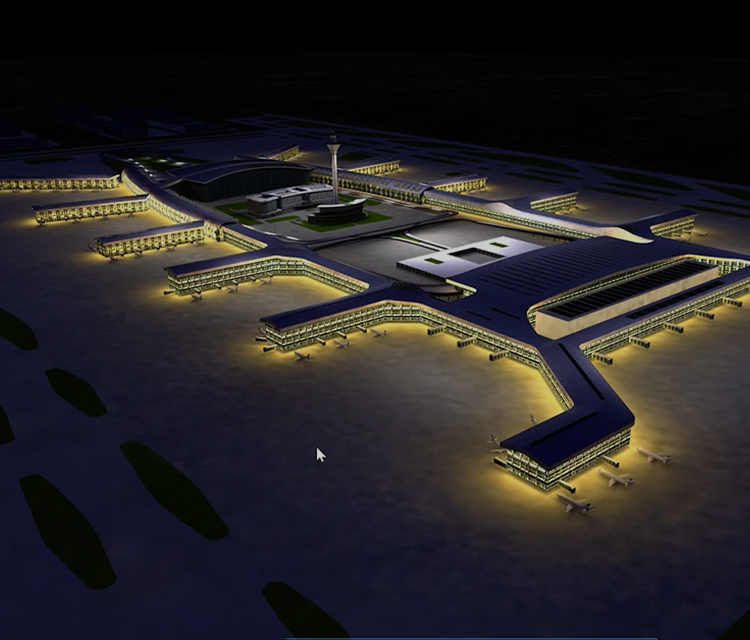
Build a refined, panoramic 3D model of the smart airport, including buildings, aircraft, special vehicles, personnel, and other entities. This visually presents the overall layout and spatial distribution of key assets, enabling managers to monitor real-time resource occupancy, flight dynamics, and passenger flow. Integrate specialized data models to bind and link virtual 3D entities with airport operational data. By merging with video surveillance platforms, match physical video monitoring points 1:1 with 3D coordinates, assisting airport managers in intuitively and conveniently obtaining operational status of designated areas.

Intelligent Applications: Meeting Multi-role Needs

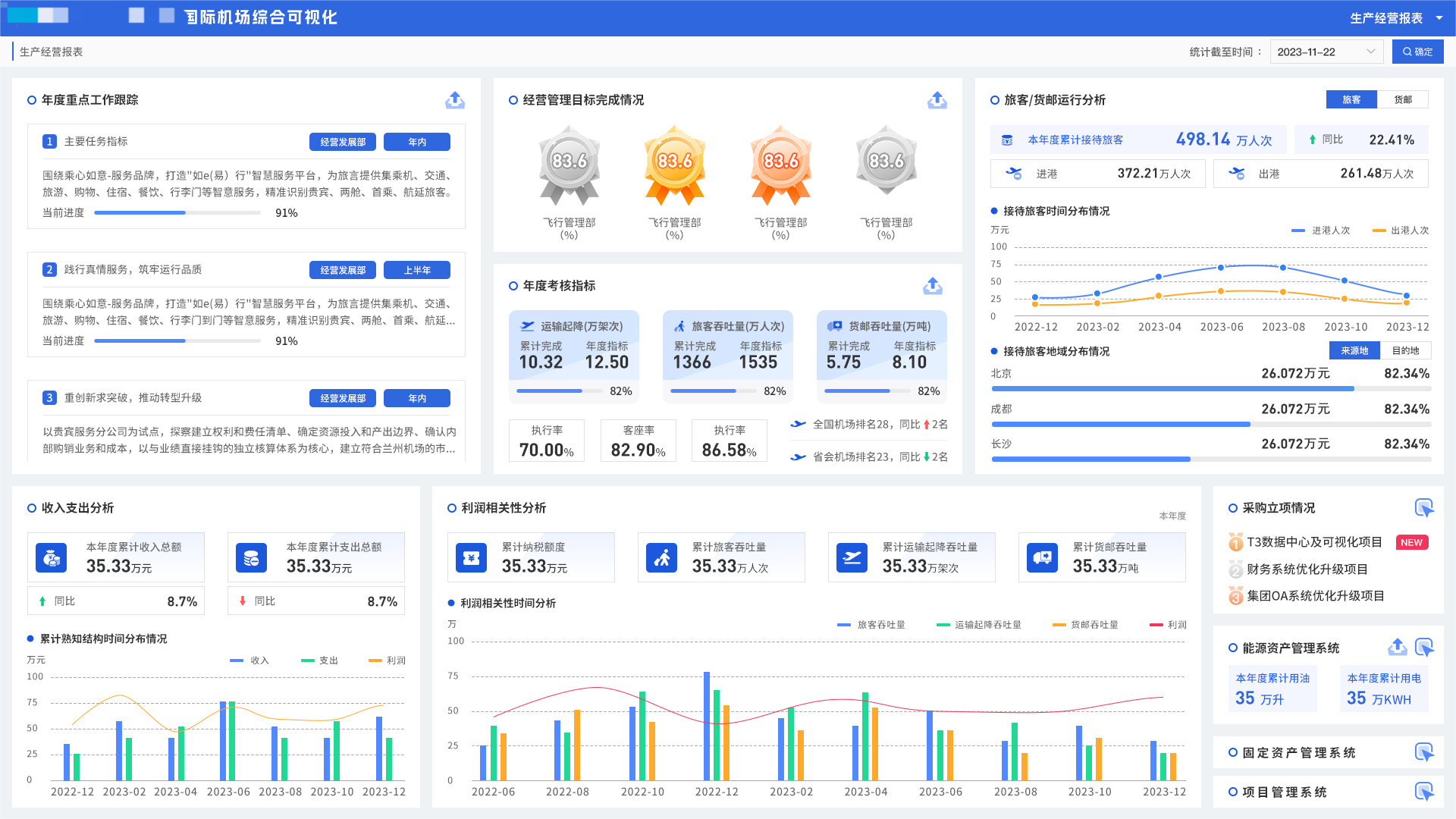
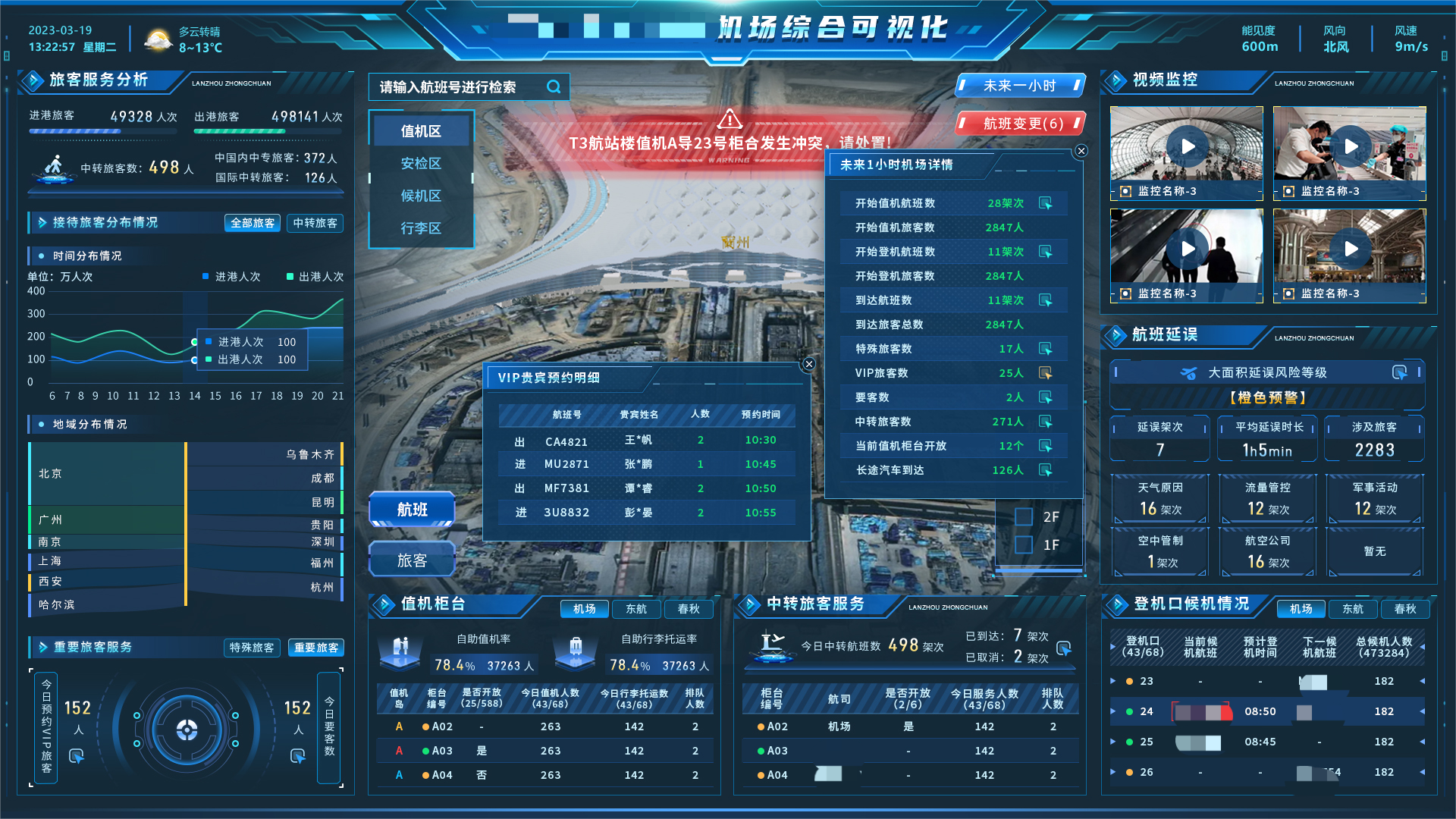
Develop full-scenario, full-element, full-process operational visualization tailored for multiple airport roles, perspectives, and domains. Panoramic dashboards provide senior management with data analysis on production, operations, and overall operational status through intelligent analytics. Flight route clearance and restriction information enable advance awareness of flight movements, congestion, and delays, supporting dynamic routing and predictive warnings to avoid delays and cancellations. IoT sensors monitor gate status, aircraft locations, and ground support progress in real time, enabling intelligent gate allocation adjustments. Key service metrics such as boarding gate occupancy and changes, baggage carousel usage, are continuously analyzed and optimized to ensure efficient resource allocation and precise response across the full service chain.

Consult Now Free trial

Holistic Planning

Implementation Value

Passenger Domain: Experience Upgrade

Through large-screen displays, the service chain presents real-time information on check-in, security, boarding, and other processes to passengers. This shortens queue times and helps airport managers and passengers better understand and address related issues, enhancing service quality and passenger satisfaction.

Through large-screen displays, the service chain presents real-time information on check-in, security, boarding, and other processes to passengers. This shortens queue times and helps airport managers and passengers better understand and address related issues, enhancing service quality and passenger satisfaction.

Operations Domain: Efficiency Leap

By integrating aviation information with 3D models on a visual monitoring platform using geographic overlay and layered management, the system delivers intuitive and realistic environmental effects and analysis results. This improves flight scheduling efficiency and gate utilization, and reduces delays through highly accurate terminal area flow forecasting.

By integrating aviation information with 3D models on a visual monitoring platform using geographic overlay and layered management, the system delivers intuitive and realistic environmental effects and analysis results. This improves flight scheduling efficiency and gate utilization, and reduces delays through highly accurate terminal area flow forecasting.

Safety Domain: Closed-Loop Control

The intelligent airport data center enhances emergency command efficiency through early warning analysis, setting alerts for MDRS, flight delays, deviations, fuel levels, communications, and more, based on critical aircraft operational parameters and threshold settings. Multi-faceted safety monitoring accelerates emergency response and comprehensively addresses daily and unexpected incidents, achieving integrated event management.

The intelligent airport data center enhances emergency command efficiency through early warning analysis, setting alerts for MDRS, flight delays, deviations, fuel levels, communications, and more, based on critical aircraft operational parameters and threshold settings. Multi-faceted safety monitoring accelerates emergency response and comprehensively addresses daily and unexpected incidents, achieving integrated event management.

Logistics Domain: Cargo Tracking

Using logistics dashboards and SVG-based maps, the system analyzes domestic and international cargo flows, enables full-process luggage tracking, and improves sorting efficiency.

Using logistics dashboards and SVG-based maps, the system analyzes domestic and international cargo flows, enables full-process luggage tracking, and improves sorting efficiency.

Commercial Domain: Intelligent Financial Reporting

By building data application dashboards, the system intelligently generates financial and business development reports, integrating passenger source analysis with consumption data to support airport operations and tenant management decision-making.

By building data application dashboards, the system intelligently generates financial and business development reports, integrating passenger source analysis with consumption data to support airport operations and tenant management decision-making.

Energy Domain: Supply Assurance

An integrated display platform consolidates data on energy charges, consumption, equipment energy use, and energy supply plans, ensuring stable airport energy supply.

An integrated display platform consolidates data on energy charges, consumption, equipment energy use, and energy supply plans, ensuring stable airport energy supply.

Success Stories

Kunming Airlines Data Analysis Platform

As a relatively young airline in China, Kunming Airlines urgently requires an intelligent data analytics and visualization platform based on big data technology. This platform should flexibly support rapid analytical models across multiple domains including passenger services, e-commerce, maintenance, cargo, and scheduling.

Learn more
A City Airport IOC

A city airport is developing an intelligent data center application system that integrates data aggregation, governance, application, intelligent service algorithms, and comprehensive visualization. Built on a cloud computing platform and various business systems, it aims to meet data management and intelligent operational needs.

Learn more

Begin Your Data Intelligence Journey Today

Consultation Free Trial